

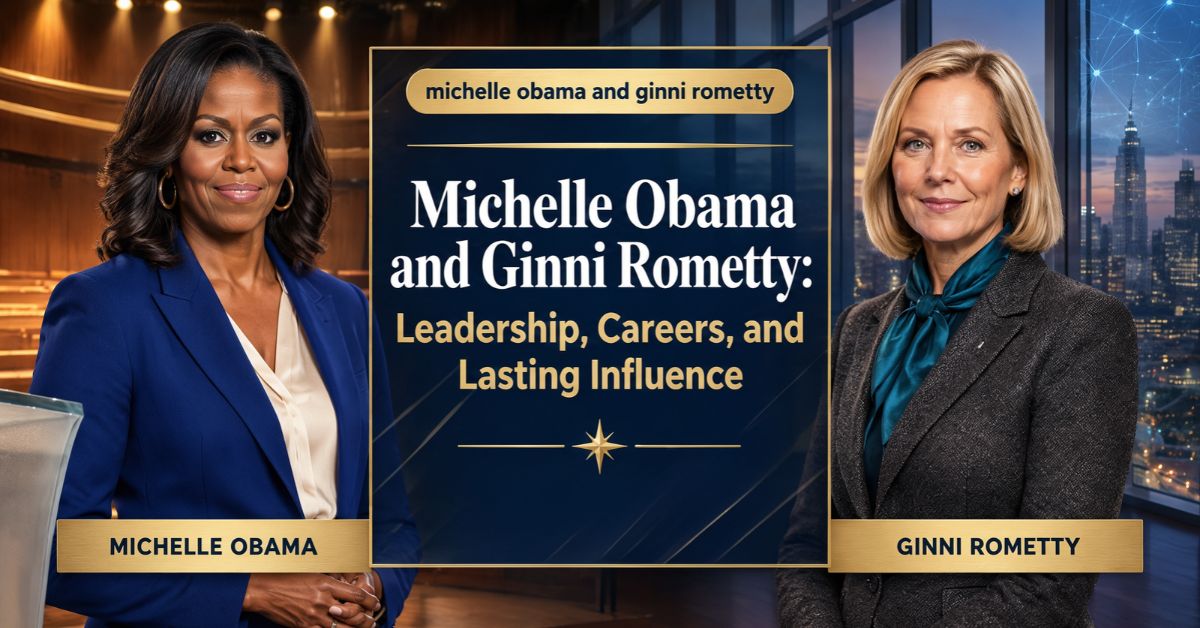
Leadership can take many forms, from influencing national conversations to transforming global businesses. Michelle Obama and Ginni Rometty represent two different but equally important examples of women who have built lasting influence through education, determination, and professional achievement. Michelle Obama, the former First Lady of the United States, is widely recognized for her work in education, public health, and women’s empowerment. Ginni Rometty, meanwhile, made history as the first woman to serve as IBM’s chairman, president, and chief executive officer.
Although their careers developed in different fields, both women demonstrated how strong leadership can create opportunities for others. Their professional journeys also highlight the importance of education, confidence, adaptability, and social responsibility. This article examines their backgrounds, career achievements, leadership approaches, educational initiatives, and lasting contributions. It also explains whether they have a direct professional connection and explores the lessons their experiences offer to future generations.
Who Are Michelle Obama and Ginni Rometty?
Michelle Obama is an American lawyer, author, and public figure who served as First Lady from 2009 to 2017. She became the first African American woman to hold that position. Her public work focused on childhood health, educational opportunities, military families, and girls’ education.
Ginni Rometty, whose full name is Virginia Marie Rometty, is an American business executive best known for leading IBM. She became the company’s CEO in 2012 and served until December 2020. Her leadership focused on technological innovation, workforce development, and preparing IBM for changes in the global technology industry.
Michelle Obama: From Legal Professional to First Lady
Michelle Obama was born in Chicago, Illinois, on January 17, 1964. She attended Princeton University, where she studied sociology and African American studies. Later, she earned her law degree from Harvard Law School in 1988.
After graduation, she joined the Chicago law firm Sidley & Austin. However, she eventually moved toward public service, working with organizations connected to community development, education, and healthcare. Her professional background helped develop the communication, organizational, and leadership skills that later shaped her public work.
In January 2009, she became First Lady when Barack Obama assumed the presidency. Rather than limiting her role to traditional ceremonial duties, she used her position to promote practical initiatives addressing important social issues.
Ginni Rometty: A Pioneer in Corporate Technology Leadership
Ginni Rometty graduated from Northwestern University with a degree in computer science and electrical engineering. She joined IBM in 1981 as a systems engineer and gradually moved into senior management positions.
Her long career within IBM gave her experience in consulting, business operations, technology, and corporate strategy. Before becoming CEO, she played an important role in integrating PricewaterhouseCoopers Consulting into IBM, expanding the company’s consulting capabilities.
In 2012, Rometty became IBM’s first female CEO. During her leadership, the company invested in cloud computing, artificial intelligence, cybersecurity, and quantum computing. IBM also acquired Red Hat in 2019, an important move in its hybrid-cloud strategy. Her career demonstrated how technical knowledge and business leadership can work together.
Michelle Obama and Ginni Rometty: A Quick Comparison
Michelle Obama and Ginni Rometty share several leadership qualities, but their professional responsibilities were different.
| Category | Michelle Obama | Ginni Rometty |
| Main profession | Lawyer, author, public advocate | Business executive |
| Education | Princeton and Harvard Law School | Northwestern University |
| Major leadership role | First Lady of the United States | Former IBM CEO |
| Main areas | Education, health, women’s empowerment | Technology, business, employment |
| Major book | Becoming | Good Power |
| Leadership platform | Public service and advocacy | Corporate leadership and innovation |
Their careers show that leadership does not depend on working in the same industry. It can develop through public service, business innovation, education, and community engagement.
Is There a Direct Connection Between Michelle Obama and Ginni Rometty?
There is no widely documented evidence establishing a close personal friendship, formal partnership, or major joint professional project between Michelle Obama and Ginni Rometty. Their names are sometimes discussed together because both became influential women in American leadership.
However, their professional worlds have some natural areas of overlap. Both have participated in broader discussions about education, workplace opportunities, women’s advancement, and social responsibility.
It is important to distinguish shared interests from a confirmed working relationship. Their individual achievements can be compared without suggesting that they collaborated directly.
Shared Interests in Education and Opportunity
Education is one of the clearest themes connecting their leadership philosophies. Michelle Obama encouraged students to continue their education beyond high school and helped promote educational access for girls around the world.
Ginni Rometty approached education through employment and technology. She supported IBM’s P-TECH initiative, which connected high school education with college-level learning and career preparation. The model helped students develop practical skills for employment in technology-related industries.
Both approaches recognized that education should prepare people for real opportunities rather than simply provide academic qualifications.
Different Platforms, Similar Social Priorities
Michelle Obama used the influence of the White House, public speaking, and community programs to encourage social change. Her initiatives reached families, students, educators, and communities across the United States and internationally.
Rometty used corporate leadership to influence employment practices, technological development, and workforce preparation. Her work demonstrated how major companies could contribute to education and economic opportunity.
Although their methods differed, both understood that leadership involves more than personal success. It also involves helping other people develop the skills and confidence needed to succeed.
Michelle Obama’s Leadership Style and Social Influence
Michelle Obama’s leadership style combines communication, personal storytelling, public engagement, and practical social advocacy. Her influence extends beyond her years in the White House.
1. Making Education a Practical Priority
Through the Reach Higher initiative, Michelle Obama encouraged students to pursue education after high school. She highlighted different pathways, including community colleges, universities, and professional training programs.
Her Let Girls Learn initiative also promoted educational opportunities for adolescent girls internationally.
2. Promoting Healthier Communities
Her Let’s Move! campaign focused on childhood obesity and healthier lifestyles. It encouraged physical activity, improved food choices, and healthier school environments.
The initiative brought together parents, schools, healthcare professionals, and community organizations.
3. Encouraging Confidence and Representation
Michelle Obama became an important public role model, particularly for young women and girls. Her speeches, public appearances, and personal experiences encouraged people to recognize their abilities and pursue ambitious goals.
Her influence also demonstrated the importance of representation in positions of national leadership.
Ginni Rometty’s Leadership Style and Business Achievements
Ginni Rometty’s leadership approach emphasized technological transformation, professional development, and adapting established businesses to changing markets.
1. Leading IBM Through Technological Change
During her time as CEO, Rometty helped reposition IBM toward higher-value technology services. The company expanded its work in artificial intelligence, hybrid cloud computing, cybersecurity, and quantum computing.
The acquisition of Red Hat in 2019 became one of the most significant strategic decisions during her leadership.
2. Supporting Skills-Based Employment
Rometty promoted the idea that employers should recognize practical abilities rather than relying exclusively on traditional university degrees.
IBM’s P-TECH initiative provided students with educational pathways connecting high school, college qualifications, and employment opportunities.
3. Advancing Women in Corporate Leadership
As IBM’s first female CEO, Rometty became a prominent example of women’s advancement in the technology industry.
Her career also encouraged conversations about professional development, workplace inclusion, and opportunities for women in senior management.
Similarities Between Michelle Obama and Ginni Rometty
Commitment to Education
Both women viewed education as a foundation for long-term opportunity. Obama concentrated on access to higher education and girls’ learning, while Rometty emphasized technical skills and employment preparation.
Breaking Traditional Barriers
Michelle Obama became the first African American First Lady. Ginni Rometty became the first woman to lead IBM as CEO. Their achievements challenged traditional expectations about who could occupy influential leadership positions.
Encouraging Future Generations
Both women used their professional experiences to encourage young people. Their work highlighted the value of preparation, confidence, education, and persistence.
Connecting Leadership With Responsibility
Their leadership philosophies also demonstrate that influence carries responsibility. Whether working in government-related advocacy or corporate management, leaders can use their positions to improve opportunities for others.
Key Differences in Their Careers and Influence
The most important difference is the environment in which they exercised leadership. Michelle Obama worked primarily through public service, social advocacy, education, and national influence.
Ginni Rometty operated within a global technology corporation, where her responsibilities included business strategy, financial performance, innovation, and organizational change.
Their measures of success were therefore different. Obama’s influence is closely associated with social initiatives and public engagement, while Rometty’s legacy is connected to IBM’s technological transformation and workforce development.
What Can We Learn From Michelle Obama and Ginni Rometty?
Their experiences provide several useful lessons for students, professionals, and future leaders.
1. Build a Strong Educational Foundation
Both women invested in education before reaching influential positions. Their careers demonstrate the importance of developing knowledge and professional skills.
2. Develop Confidence Through Preparation
Confidence becomes stronger when supported by experience, discipline, and continuous learning.
3. Be Willing to Change Direction
Michelle Obama moved from corporate law toward public service, while Rometty developed her career through different technical and management positions.
4. Create Opportunities for Others
Successful leadership should also help other people develop their abilities and achieve professional goals.
5. Balance Ambition With Responsibility
Personal achievement becomes more meaningful when it contributes to families, communities, workplaces, and society.
Why Their Leadership Matters for Women Today
Michelle Obama and Ginni Rometty demonstrate that women can influence society through different professional pathways. One became a prominent public advocate, while the other led a major international technology company.
Their achievements are particularly relevant in industries and institutions where women have historically faced barriers to senior positions. Their careers encourage organizations to value talent, education, professional experience, and inclusive leadership.
They also show younger generations that leadership does not require following a single career path. Women can make meaningful contributions through law, business, education, technology, public service, and entrepreneurship.
Their Influence on Education and Future Employment
Education and employment are closely connected in both women’s work. Michelle Obama’s initiatives encouraged students to pursue further education and helped draw attention to barriers affecting girls’ access to learning.
Rometty focused on preparing students for a changing employment market. IBM’s P-TECH model offered an alternative pathway combining academic education with technical training and workplace experience.
Together, these approaches highlight an important principle: educational systems should prepare students not only to earn qualifications but also to participate confidently in the modern economy.
Books That Help Explain Their Leadership Philosophies
Their published books provide additional insight into their personal experiences and approaches to leadership.
Michelle Obama — Becoming
Published in 2018, Becoming is Michelle Obama’s memoir. It discusses her childhood in Chicago, education, professional experiences, family life, and years in the White House.
The book explores identity, personal growth, ambition, and the challenges of balancing professional and personal responsibilities.
Ginni Rometty — Good Power
Published in 2023, Good Power: Leading Positive Change in Our Lives, Work, and World explains Rometty’s experiences as a business leader.
The book explores career development, leadership decisions, workplace culture, and the importance of using influence to create positive change.
Both books offer lessons about resilience, preparation, and personal development, although they approach leadership from different perspectives.
Common Misunderstandings About Michelle Obama and Ginni Rometty
Mistake 1: Assuming They Worked Together
Their shared interests do not establish a formal partnership. There is no widely documented major joint project between them.
Mistake 2: Treating Their Leadership Roles as Identical
Obama’s public advocacy and Rometty’s corporate responsibilities involved different objectives, challenges, and measures of success.
Mistake 3: Assuming Their Careers Were Free From Challenges
Both women experienced demanding professional environments and had to make difficult decisions throughout their careers.
Mistake 4: Measuring Leadership Only Through Recognition
Awards and public attention do not fully measure leadership. Their contributions to education, professional opportunities, and organizational development are also important.
Frequently Asked Questions
1. Who are Michelle Obama and Ginni Rometty?
Michelle Obama is a former First Lady of the United States, lawyer, and author. Ginni Rometty is the former chairman, president, and CEO of IBM.
2. Are Michelle Obama and Ginni Rometty friends?
There is no widely verified public information establishing a close personal friendship between them.
3. Have Michelle Obama and Ginni Rometty worked together?
No major joint professional project or formal partnership between them is widely documented.
4. What is Michelle Obama best known for?
She is known for serving as First Lady from 2009 to 2017 and promoting education, childhood health, girls’ education, and women’s empowerment.
5. What made Ginni Rometty an important business leader?
She became IBM’s first female CEO and guided the company’s strategic development in areas such as artificial intelligence, hybrid cloud computing, and workforce transformation.
Conclusion
Michelle Obama and Ginni Rometty represent two different approaches to leadership, but their careers share important lessons about education, determination, opportunity, and responsibility. Michelle Obama used public influence to support healthier communities, educational access, and women’s empowerment. Ginni Rometty transformed her technical and management experience into corporate leadership, helping IBM adapt to major technological changes.
Their journeys demonstrate that successful leadership is not limited to one profession or industry. It requires continuous learning, confidence, adaptability, and a willingness to create opportunities for others. Although there is no established major professional partnership between them, Michelle Obama and Ginni Rometty remain valuable examples of women who challenged traditional expectations. Their experiences encourage future generations to pursue ambitious goals while making meaningful contributions to society.

Dylan Scott is an SEO strategist, digital marketing consultant, and language trends researcher at Correct Magzine. Dylan has led SEO content optimization and search visibility projects for businesses across multiple industries, specializing in text slang meanings, semantic SEO, and data-driven content that prioritizes accuracy, expertise, and user trust.